

How to Fill Out Divorce Papers: A Practical Step-by-Step Guide
Divorce forms turn your circumstances and requests into a court record. Learn what to enter, what to verify, and which mistakes to catch before signing and filing.
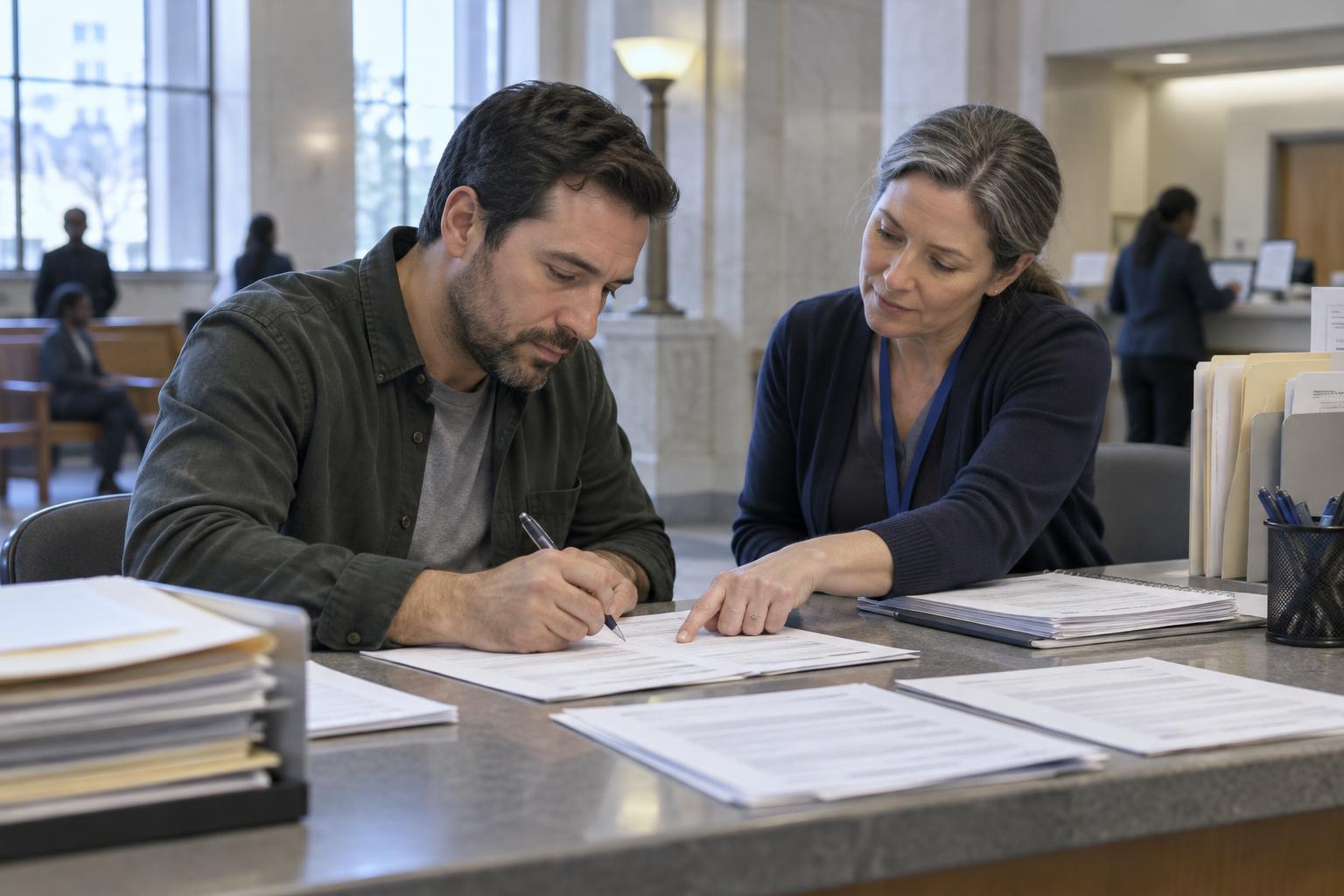
To fill out divorce papers, use your state and county’s current court forms, follow each form’s instructions, and accurately list your marriage details, finances, children, and requests for court orders. Complete every required section, sign only as directed, and check the packet before filing and arranging any required service. If you received papers from your spouse, you generally need response forms—not a new divorce petition.
The hardest part is often deciding what a checkbox means, not typing in your name. This guide explains common fields, but laws and forms vary by state. Divorcesify provides general information, not legal advice; speak with a local divorce attorney about uncertain rights or requests.
1. Which divorce papers do you need to complete?
Start at your state court’s official self-help website and your county court’s family-law page. Confirm that the packet applies to your situation: starting a divorce, responding to one, or submitting an agreed case.
Packets may differ depending on whether you have minor children, need support, or qualify for a simplified procedure. Check for county-specific forms and instructions, too. An old packet from a friend may no longer be accepted.
Understand what each form does
Titles vary, but these documents are common:
| Document | What you usually enter | Important distinction |
|---|---|---|
| Petition or complaint | Marriage facts, legal grounds, and requested orders | Starts the case; it is not the final judgment |
| Summons | Party names, court information, and other fields directed by instructions | Often requires clerk issuance before service |
| Response or answer | Admissions, denials, and your position on requested relief | Used when your spouse has already filed |
| Financial disclosure or affidavit | Income, expenses, assets, and debts | May be filed, exchanged privately, or both |
| Child-related declaration | Children’s information, residence history, and related cases | Helps the court assess custody jurisdiction |
| Settlement agreement | Specific terms both spouses accept | Has consequences beyond completing basic forms |
| Proposed judgment or decree | Orders you want the judge to enter | Usually belongs to a later stage |
Read the packet’s checklist before writing. Some documents are submitted together; others have separate deadlines.
If you were served, identify your response deadline immediately. Negotiating with your spouse does not automatically extend it. Ask whether you need a counterpetition to request your own relief.
2. How do you complete the court heading and personal information?
The heading at the top of a court form is called the caption. Copy it consistently across every document.
Court, names, and case number
Enter the correct court and county. Use your legal name and your spouse’s legal name, including other names only where requested.
The spouse starting the case is commonly the petitioner or plaintiff; the other is the respondent or defendant. Those labels generally stay the same even when the respondent files a document.
For a new case, leave the case number blank if the clerk assigns it upon filing. For an existing case, copy the number exactly. Leave judge, clerk, and court-use fields blank unless instructions say otherwise.
Addresses and sensitive information
Provide the mailing address and contact information required by the form. Do not assume a court filing stays private. Follow instructions for confidential information sheets and redacting account numbers or other identifiers.
If revealing your address could put you or your children at risk, ask about protected-address procedures before filing. A court self-help center, local attorney, or domestic violence advocate can explain available options. Do not simply invent an address or omit required information without checking the procedure.
3. What should you enter for marriage details and divorce grounds?
Gather your marriage certificate, a timeline of where each spouse has lived, and any existing family-court orders. Use records rather than guessing.
Marriage, separation, and residency dates
Forms commonly ask for:
- The date and location of the marriage.
- Each spouse’s current residence and length of residency.
- A separation date, if relevant under state law.
- Whether either spouse has filed another divorce case.
- Whether there are existing custody, support, or protective orders.
A separation date is not always the day someone moved out. Depending on state law, spouses may be separated while sharing a home, or physical separation alone may not settle the issue. If the date is disputed, get advice before presenting it as agreed.
Residency requirements determine where and when you may file. Enter accurate dates; do not round up to meet a requirement. Custody jurisdiction can involve different rules from divorce residency.
Grounds for divorce
Use the grounds recognized in your state and listed in the instructions. No-fault wording may refer to an irretrievable breakdown or irreconcilable differences.
Do not assume that describing misconduct improves your case. Fault claims, where available, can create additional proof requirements. Include factual allegations only where requested or legally relevant, and avoid turning a short-answer field into a history of the relationship.
4. How do you fill out requests for property, support, and other orders?
The section labeled “relief requested” tells the court what you want it to decide. It deserves more attention than routine identifying information.
Checking a box requests an order; it does not mean the judge has granted it. Conversely, leaving out a request may limit your options, particularly if your spouse defaults. Amendment procedures vary.
Read each choice carefully
Common requests include:
- Division of marital property and debts.
- Confirmation that specified property is separate property.
- Spousal support, sometimes called alimony or maintenance.
- Child custody, parenting time, and child support.
- Attorney fees or litigation costs.
- Restoration of a former name.
“No support requested,” “support waived,” and “reserve support” can have very different effects. In some circumstances, waiving support may permanently close that option. Do not select a waiver merely because you are unsure what to request.
Similarly, “we have already divided everything” may be inaccurate if retirement benefits, a business interest, joint debt, or a tax obligation remains unresolved.
Identify property without assuming ownership rules
A vehicle titled to one spouse or an account held individually is not necessarily separate property. Classification can depend on when and how it was acquired and the source of funds.
If you need more space, use an authorized attachment. Label it with the form name and question number, and follow local rules for identifying the case. Avoid adding an informal side agreement and assuming it becomes enforceable.
Requests for temporary support or emergency protection often require separate filings; checking a petition box may not be enough.
5. How do you complete financial disclosures accurately?
Financial forms generally require a fuller picture than the opening petition. Collect recent pay statements, tax returns, bank and investment statements, retirement records, loan statements, and household bills.
Match the form’s time periods and definitions
Check whether each line asks for weekly, monthly, or annual amounts. Distinguish gross income before deductions from net take-home pay.
For example, if the form requests average monthly gross income and you earn $1,200 weekly, the usual annualized calculation is:
$1,200 × 52 ÷ 12 = $5,200 per month.
Follow the court’s instructions if they specify a different method. Multiplying weekly pay by four can understate average monthly income.
List bonuses, commissions, overtime, self-employment income, and other sources where requested. For variable income, identify the period used for your average. Business revenue is not automatically personal income; use the form’s required treatment of business expenses.
Separate values, balances, and estimates
For each asset or debt, identify the owner or account holder, current value or balance, valuation date, and any required classification. State whether a number is estimated when the form permits, and keep the records supporting it.
For example, a car worth an estimated $18,000 with a $7,000 loan has approximately $11,000 in equity. If the form has separate lines for value and debt, do not enter only the equity.
For expenses, distinguish actual spending from projected post-separation costs. Avoid counting the same expense twice.
Do not omit an account because your spouse knows about it or because you believe it is separate property. Required disclosures may cover both marital and separate assets. If information is unavailable, follow the procedure for reporting that and supplementing later rather than inventing a number.
6. What information belongs in divorce papers involving children?
Use the packet designed for your situation. Forms may ask about minor children, pregnancy, legal parentage, and older dependent children. Questions involving adoption, assisted reproduction, or disputed parentage deserve legal review.
Residence history and related proceedings
Child-related declarations often request where children have lived, who lived with them, and information about other custody proceedings. Provide the full history for the period requested—not just the current address.
Disclose relevant cases or orders, including protective orders and proceedings in another state, as required. Do not assume the judge can see another court’s records automatically. Ask about confidentiality procedures if disclosure creates a safety risk.
Custody and support requests
Distinguish decision-making authority from the parenting schedule. “Joint custody” alone may not explain where a child will sleep or who makes medical and school decisions.
If a parenting plan is required, address ordinary weeks, holidays, transportation, exchanges, and communication. Make requests specific enough to follow while accounting for work schedules and school needs.
Use the required child-support worksheet rather than substituting an informal agreement. Equal parenting time does not automatically eliminate support. Parents generally cannot privately waive a child’s support rights without the required court review.
7. What should you check before signing, filing, and serving?
Do a separate accuracy review after completing the packet. Reading once for names and dates, then again for financial figures and requested orders, can catch different mistakes.
Final review checklist
- Required fields: Use “not applicable” only where appropriate; do not use it to avoid an unknown answer.
- Consistency: Match names, dates, case numbers, and dollar amounts across forms.
- Attachments: Include required schedules and label continuation pages correctly.
- Privacy: Use confidential forms and required redactions.
- Signatures: Check which documents require notarization or a declaration under penalty of perjury.
- Court-use sections: Leave clerk and judge signature areas untouched.
- Copies and format: Follow paper-copy or e-filing requirements and keep a complete copy.
Do not sign a notarized document before the notary instructs you to do so. Never sign your spouse’s name. If electronic signatures are allowed, follow that court’s rules.
Get help with uncertain answers
Court self-help staff may explain forms and procedures, but generally cannot choose legal positions for you. A local divorce attorney offering limited-scope services may review the packet without handling the entire case.
Prioritize review if you are waiving support, dividing retirement benefits, dealing with a business, or resolving safety or interstate custody issues.
Filing does not complete every step
Submit the packet through an approved method, pay the filing fee or request a waiver, and keep file-stamped copies. Arrange service according to local rules; handing papers to your spouse yourself is often insufficient.
If you discover an error after filing, ask about amended or corrected documents and whether new service is required. Do not silently change your copy and treat it as the court record.
Key takeaways
- Use current official forms for your state, county, and role in the case.
- Verify dates and financial figures instead of guessing.
- Treat requests and waivers as legal decisions, not routine checkboxes.
- Protect sensitive information through approved confidentiality procedures.
- Check signatures, attachments, filing requirements, and service separately.
- Ask a local divorce attorney to review anything that could affect your property, support, or parental rights.
Frequently asked questions
Can I fill out divorce papers myself?
Yes. You can generally complete divorce papers without hiring an attorney, using official court forms and instructions. Self-help centers may explain procedures, but they usually cannot advise you on which rights to request or waive. Consider a limited-scope attorney review if you have children, significant assets, support questions, or safety concerns.
Can divorce papers be handwritten?
Some courts accept neatly handwritten forms, while others require typed documents or particular electronic formats. Check your court’s instructions before completing the packet. If handwriting is allowed, use the specified ink color, write clearly, and avoid crowded answers. Use approved continuation sheets when a field does not provide enough space.
Do divorce papers need to be notarized?
Some divorce documents require notarization, but not every form does. Others use a signed declaration under penalty of perjury. Read each signature block and the packet instructions. If notarization is required, wait to sign until the notary directs you. Also check whether your court permits electronic signatures or remote notarization.
What if I do not know an answer on a divorce form?
Do not guess or substitute “not applicable” for information you lack. Check the instructions for whether you may enter “unknown,” provide an explanation, or supplement the information later. Try to obtain supporting records. If the missing answer affects residency, service, finances, or custody jurisdiction, seek procedural guidance or legal advice promptly.
What happens if I make a mistake on divorce papers?
The next step depends on whether you have filed the document and how serious the mistake is. Before filing, correct it using the court’s accepted format. After filing, you may need an amended document, permission from the court, or renewed service. Ask the self-help center about procedure and an attorney about substantive changes.
AI-assisted general information from Divorcesify. This article has not been represented as reviewed by a licensed attorney; confirm current local law before acting.
Find your state’s divorce rules · Explore divorce process guides · Prepare for your attorney consultation
Attorney advertising. Divorcesify is not a law firm, is not a lawyer referral service, and does not provide legal advice. Information on this site is general and may not reflect current law in your state. Using this site or submitting a form does not create an attorney-client relationship. Divorcesify matches visitors with independent, licensed attorneys who pay a fee to participate. We do not endorse or guarantee any attorney, and the choice of a lawyer is an important decision that should not be based solely on advertisements. Read full disclosures.
Get the Divorce Preparation Guide
Checklists, a post-divorce budget outline, and the questions to ask your first attorney — free.
Keep reading

Temporary Orders in Divorce: What They Do and How to Ask
Divorce can take time, but decisions about children, housing, and bills often cannot wait. Temporary orders can establish enforceable rules while your case moves forward.

Who Claims a Child on Taxes After Divorce?
The parent entitled to claim a child for federal tax purposes is not always the parent named in a divorce agreement. Learn how overnight stays, IRS Form 8332, and different tax benefits fit together.

How to File for Divorce in California: Step-by-Step
Filing for divorce in California starts with residency, court forms, and proper service—but those steps do not end the marriage. Follow this practical guide through disclosures, settlement options, and the final judgment.