

Divorce Papers Online: Find, Prepare, and Use the Right Forms
You can usually find divorce forms online, but downloading them does not start or finish a divorce. Learn how to locate the correct packet, prepare it accurately, and understand what happens next.
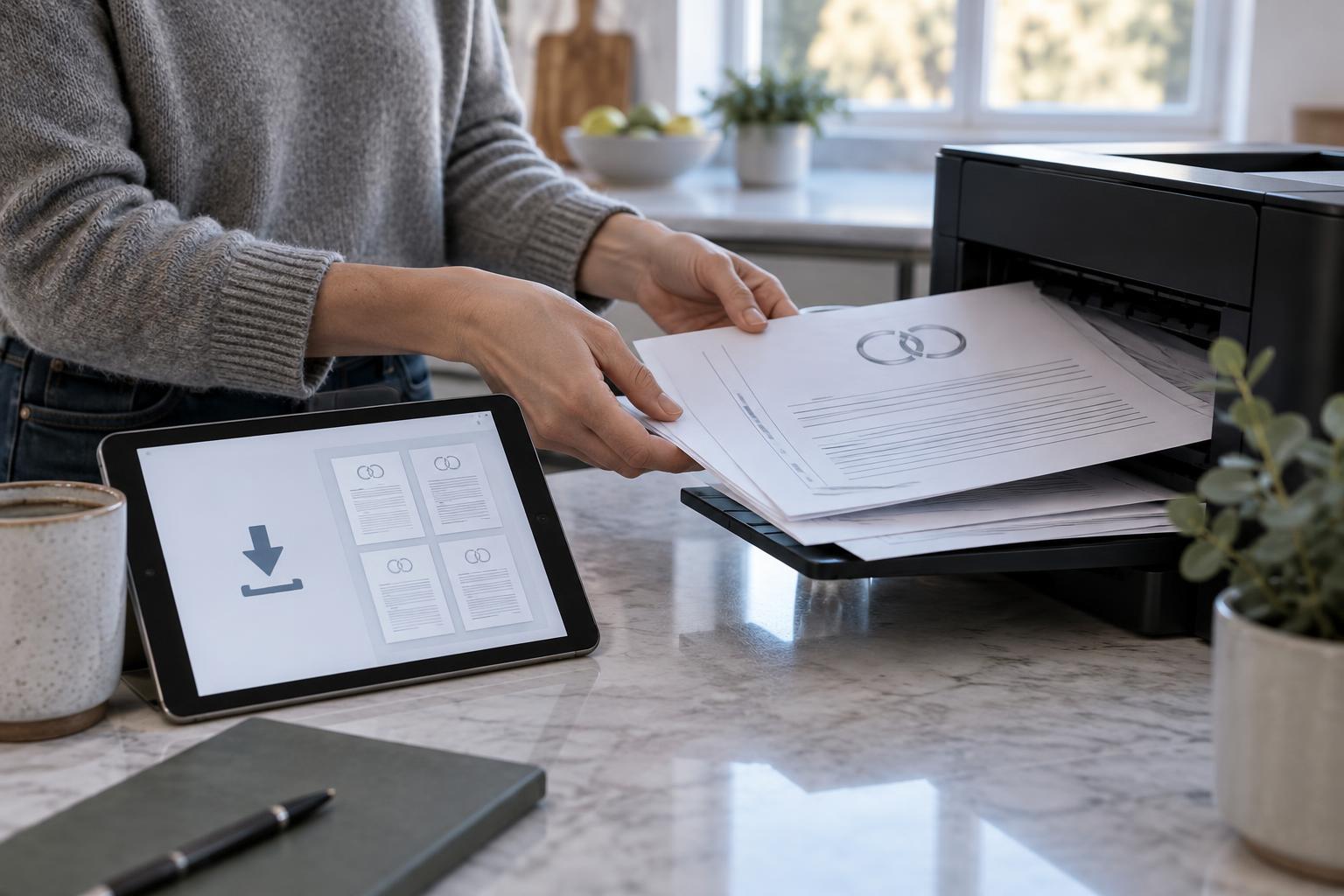
You can usually get divorce papers online from your state court system, county court website, or an official court self-help program, often for free. The correct packet depends on where you can legally file, whether you have minor children, and whether the case is agreed or disputed. Downloading or completing papers does not start or finalize a divorce; filing, legally required notice, and court approval are separate steps.
What does “divorce papers online” mean?
People use this phrase for several different things. Knowing which one you need can prevent paying for the wrong product or submitting the wrong document.
- Blank divorce forms: Official documents you download, complete, and submit.
- Guided form preparation: An online interview that turns your answers into completed paperwork.
- Electronic filing: A court-authorized system for submitting documents to the clerk.
- Existing case documents: Papers already filed in your case, including a final divorce decree.
A website may provide only one of these services. For example, a paid document-preparation service might create PDFs but leave filing and service entirely to you.
If you are already divorced and need proof, do not buy a new divorce packet. Contact the court that entered the judgment for a copy of your decree. An online docket may offer document downloads, but a certified copy may require a separate request. A vital-records divorce certificate is not necessarily a substitute for the full decree.
Where can you find legitimate divorce forms online?
Start with the court where you plan to file
First, confirm the state and county where you are eligible to file. Residency and venue rules matter; downloading a particular court’s forms does not establish eligibility to use that court.
Search for your state judiciary’s official website and look for “divorce,” “dissolution of marriage,” “family law forms,” or “self-help.” Then check the local court’s website for supplemental forms and filing instructions. USA.gov’s divorce information page is another government starting point.
Official resources may include downloadable PDFs, fillable forms, or guided interviews. Not every state provides a complete statewide packet, and some courts require additional local documents.
Check the packet before completing it
Look for:
- The correct state, court, and case type.
- Separate instructions for cases with and without minor children.
- A revision date and any notice that older versions are no longer accepted.
- A checklist explaining which documents start the case and which come later.
- Local requirements for filing, signatures, service, and proposed orders.
Download forms directly from the official source when possible. A search-engine preview or an old PDF saved on another website may omit updated instructions.
Court-sponsored forms are commonly free to download. That does not mean the divorce itself is free: filing, service, copies, and other expenses may still apply. Courts may offer fee waivers or deferrals based on eligibility.
Which divorce papers do you actually need?
There is no universal US divorce packet. Document names vary, and some courts combine several functions into one form.
This table explains common categories—not a checklist that applies to every case.
| Document category | What it generally does | Important limitation |
|---|---|---|
| Petition or complaint | Asks the court for a divorce and identifies requested relief | Usually begins the case only when properly filed |
| Summons or notice | Gives the other spouse formal notice and response information | Must be issued and delivered as local rules require |
| Response or answer | Allows the responding spouse to address the petition | A settlement discussion usually does not replace a required response |
| Financial disclosure or affidavit | Reports income, expenses, assets, and debts | Some disclosures are exchanged rather than publicly filed |
| Child-related forms | Address custody jurisdiction, parenting arrangements, or support | Requirements depend on the children and issues involved |
| Settlement agreement | Records agreed terms for the court to consider | Signatures alone do not finalize the divorce |
| Proposed judgment or decree | Presents the final terms for judicial approval | It is not a final order merely because you completed it |
| Proof of service or authorized waiver | Documents legally sufficient notice or an accepted alternative | Informal delivery may not meet court requirements |
You may also need a confidential-information sheet, cover sheet, fee-waiver application, or hearing-request form.
Choose the correct procedural path
A petitioner’s starter packet is different from a respondent’s answer packet. Joint petitions, agreed divorces, and default cases may each require different documents where those procedures are available.
Having no minor children does not automatically make a case simple. Retirement benefits, real estate, support, business interests, or substantial debt can require language that a basic packet does not address adequately.
Also, “uncontested” generally means the required issues are resolved—not merely that both spouses want the marriage to end.
Should you use free court forms or a paid preparation service?
Free official forms are often a reasonable starting point when you understand the instructions and can identify the correct packet. Court self-help centers and legal aid programs may provide additional guidance.
A paid service may make preparation more convenient by asking questions, populating forms, and organizing next steps. But payment does not guarantee legal accuracy, acceptance by your court, or a fair settlement.
Before purchasing, ask:
- What exactly is included? Blank forms, completed forms, filing assistance, or actual attorney review?
- Does it support my court and situation? Confirm county coverage and exclusions.
- Which costs are extra? Filing, service, revisions, subscriptions, and legal consultations may be separate.
- What happens if the clerk rejects the documents? Check correction and refund terms.
- How is sensitive information protected? Review storage, sharing, account security, and deletion policies.
A “court acceptance guarantee” is not a promise that a judge will approve every requested term. Likewise, a service describing itself as “online divorce” may be a document business rather than a law firm.
Avoid sites promising an instant divorce or suggesting that one generic packet works everywhere. If you need advice about what to request or give up, a limited-scope consultation with a local divorce attorney may be more valuable than document preparation alone.
How do you complete and use online divorce papers?
1. Gather reliable information
Collect identifying and contact information, marriage details, information about children, and existing family-court orders. Gather financial records such as account statements, income records, debts, property documents, and retirement-plan information.
Use records rather than guesses where possible. Keep a list of missing information and follow the form instructions for unknown answers. Do not omit property simply because only one spouse’s name appears on the account or title.
If disclosing your location could create a safety risk, ask about address-confidentiality procedures before placing your home address on a form.
2. Complete the current forms carefully
Use consistent names, dates, and case information throughout the packet. Read the instructions for every attachment, including forms that must be exchanged with your spouse but not filed.
Avoid entering full Social Security numbers, financial account numbers, or other protected information in public documents unless the court specifically requires it in that location. Courts often use confidential forms or redaction rules.
A browser’s fillable-PDF feature may not save every field correctly. Save your work, reopen the file, and review the completed document before printing or uploading it.
3. Follow the signature rules
Some documents require a signature under penalty of perjury. Others may require notarization or a particular type of electronic signature. Do not assume that typing your name is valid for every form—or that every form needs a notary.
Read the instructions before signing, especially if a notary must witness the signature. Each spouse should sign only the documents they are supposed to sign. Never sign your spouse’s name or use their electronic account without authorization.
4. Submit through an approved filing method
Your court may accept electronic filing, paper filing, mail, or some combination. An emailed attachment is not necessarily a valid filing.
Use the filing method authorized for your case and follow document-formatting requirements. Check whether you need separate PDFs, particular document categories, or an application to waive fees.
After submission, look for the court’s acceptance confirmation and filed copies. A payment receipt or upload notification may not establish that the clerk accepted the documents. If the filing is rejected, address the stated problem promptly; do not assume an attempted submission preserved a deadline.
5. Arrange notice and complete the remaining process
Filing generally does not eliminate the requirement to give your spouse legally sufficient notice. Depending on local law, that may involve an authorized process server, sheriff, another permitted adult, or a valid acknowledgment or waiver.
Texting or emailing papers yourself is not automatically proper service. Follow the court’s rules and submit the required proof.
The case may then require disclosures, additional filings, parenting education, a waiting period, or a hearing. Keep track of deadlines and obtain the entered final judgment before treating the divorce as complete.
When are standard online papers not enough?
Online forms can organize information, but they cannot reliably identify every legal right or risk. Get individualized help when:
- You and your spouse disagree about children, support, property, or debt.
- You suspect missing financial information or feel pressured to sign.
- There is abuse, stalking, intimidation, or financial control.
- A spouse lives abroad, cannot be located, or is on military service.
- You have a business, complex compensation, retirement benefits, or property in another jurisdiction.
- An existing agreement or order affects what you can request.
Even agreed cases can need extra documents. For example, an agreement to divide certain retirement benefits may require a separate, plan-compliant court order; a sentence in the divorce decree may not accomplish the transfer.
Laws vary by state, and local procedures matter. Speak with a local divorce attorney about uncertain terms before signing. If cost is a barrier, ask about limited-scope representation or find an eligible legal aid provider through the Legal Services Corporation’s directory. Divorcesify provides general information, not legal representation.
What should you check before submitting your packet?
Do one final review against the court’s instructions:
- Correct packet: Right court, procedural role, and child-related category.
- Complete information: Required answers, attachments, and consistent dates.
- Proper signatures: Including any required notarization or verification.
- Protected information: Confidential forms and required redactions used correctly.
- Submission requirements: Fees or waiver request, file format, and copies.
- Next steps: A plan for service, disclosures, and deadline tracking.
Save a secure copy of everything you submit and receive. If you share devices or online accounts with your spouse, consider whether saved passwords, shared folders, or notification previews could expose sensitive documents.
Key takeaways
- Start with official state and local court websites for divorce papers online.
- Downloading forms, preparing them, filing them, and obtaining a final divorce are separate steps.
- Choose documents based on your court, your role in the case, children, and unresolved issues.
- Paid preparation services do not necessarily include filing, service, or legal advice.
- Follow signature, confidentiality, filing, and notice requirements carefully.
- Seek local legal advice before signing terms you do not understand or cannot safely negotiate.
Frequently asked questions
Can I download divorce papers online for free?
Often, yes. Many state court systems and local courts provide free divorce forms, instructions, or guided preparation tools. Availability varies, and you may need supplemental county forms. Free downloads do not eliminate filing or service costs, although eligible applicants may request a fee waiver or deferral.
Are divorce papers downloaded online legally valid?
Online forms can be valid when they are appropriate for your court, current, accurately completed, and properly signed and submitted. Their online origin is not the deciding factor. A completed petition or agreement also does not itself end the marriage; the court must complete the required process and enter a final judgment.
Can I sign divorce papers electronically?
Sometimes. Courts and document types have different signature requirements, and some accept specified electronic signatures. Others require handwritten signatures, notarization, or additional verification. Check the instructions for each document and the court’s electronic-filing rules. A commercial signing platform’s acceptance of your signature does not establish that the court will accept it.
Can I use online divorce papers if my spouse disagrees?
You may still be able to use official online forms to start or respond to a contested divorce. However, a packet designed for an agreed divorce may not fit your case. Disputes can require additional filings, evidence, and hearings, so consider getting legal advice about your requests and deadlines.
Can I get a copy of my finalized divorce papers online?
Possibly. The court that handled your case may offer online access to its docket or certain documents, but access and privacy restrictions vary. If you need a certified divorce decree, check the clerk’s ordering procedure. A downloadable copy or a divorce certificate may not satisfy an organization requesting a certified judgment.
AI-assisted general information from Divorcesify. This article has not been represented as reviewed by a licensed attorney; confirm current local law before acting.
Find your state’s divorce rules · Explore divorce process guides · Prepare for your attorney consultation
Attorney advertising. Divorcesify is not a law firm, is not a lawyer referral service, and does not provide legal advice. Information on this site is general and may not reflect current law in your state. Using this site or submitting a form does not create an attorney-client relationship. Divorcesify matches visitors with independent, licensed attorneys who pay a fee to participate. We do not endorse or guarantee any attorney, and the choice of a lawyer is an important decision that should not be based solely on advertisements. Read full disclosures.
Get the Divorce Preparation Guide
Checklists, a post-divorce budget outline, and the questions to ask your first attorney — free.
Keep reading

Temporary Orders in Divorce: What They Do and How to Ask
Divorce can take time, but decisions about children, housing, and bills often cannot wait. Temporary orders can establish enforceable rules while your case moves forward.

Who Claims a Child on Taxes After Divorce?
The parent entitled to claim a child for federal tax purposes is not always the parent named in a divorce agreement. Learn how overnight stays, IRS Form 8332, and different tax benefits fit together.

How to File for Divorce in California: Step-by-Step
Filing for divorce in California starts with residency, court forms, and proper service—but those steps do not end the marriage. Follow this practical guide through disclosures, settlement options, and the final judgment.