Texas Divorce Forms: Free Packets and What You Need to File
The right Texas divorce forms depend on whether you have minor children, existing court orders, and an agreed or disputed case. Learn where to find free packets, what each document does, and what to check before filing.
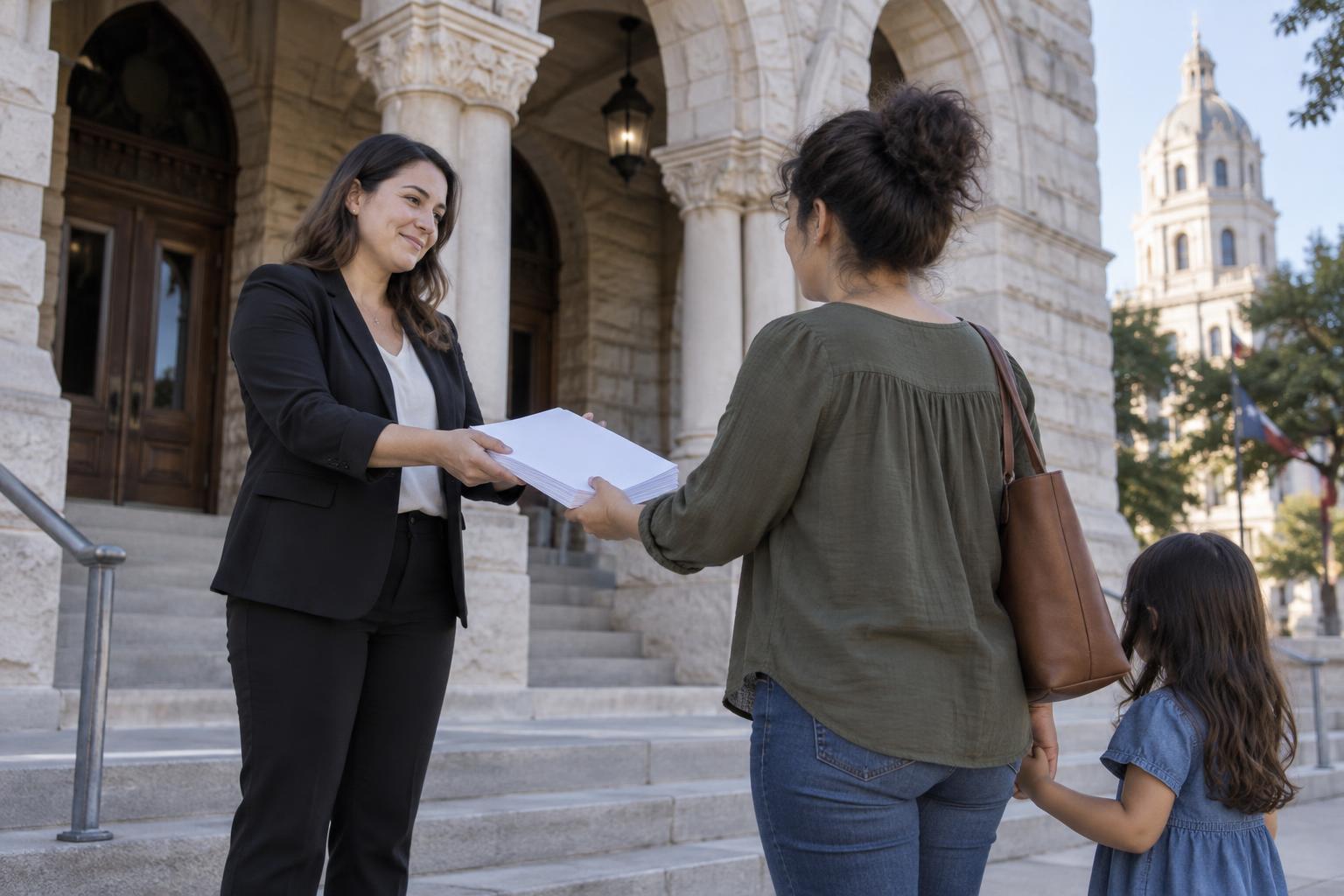
You can get free Texas divorce forms through TexasLawHelp and the Texas Judicial Branch, but the correct packet depends on your children, existing court orders, and whether your spouse will participate. Most cases begin with an Original Petition for Divorce and end with a judge-signed Final Decree of Divorce; additional documents handle service, financial disclosures, children, and filing-fee relief. There is no single packet that safely fits every divorce.
Where can you find free Texas divorce forms?
Start with these resources rather than a generic download that promises to work everywhere:
- TexasLawHelp’s divorce resources: Free guided instructions and form sets organized by family situation. Read the eligibility section before downloading documents.
- Texas Judicial Branch forms: Court-approved forms and statewide resources. Some simplified divorce forms have narrow eligibility requirements, including restrictions involving children and real property.
- Your county’s district clerk and assigned court: Check their official websites for filing instructions, standing orders, local forms, and procedures for getting a final hearing. In some counties, another authorized court handles family cases.
TexasLawHelp is a legal-information resource, not the court where you file. The clerk accepts filings and can explain administrative procedures, but cannot choose your legal strategy or tell you what settlement to accept.
Free forms do not mean a free divorce. Filing, service, copies, and other expenses may apply unless you qualify for relief from court costs. You do not need to buy a commercial package simply to obtain basic forms.
Divorce laws vary by state, and local procedures differ within Texas. Divorcesify provides general information, not legal representation. Speak with a local divorce attorney if you are unsure whether a packet fits your circumstances.
Which Texas divorce forms packet fits your situation?
Choose the packet before you start typing. Using the wrong version can leave essential issues out of your final order.
No minor children together
Look for a divorce-without-children packet if you and your spouse do not have children together who fall within the packet’s child-related eligibility rules. Read those rules carefully: a child who is 18 but still in high school, pregnancy, or an adult child with a disability may require additional analysis.
A packet labeled “without children” does not necessarily mean it handles every property issue. Some simplified forms exclude real estate; others provide options for dividing it.
Minor children together
Use a packet designed for divorcing parents when appropriate. It must address conservatorship—Texas’s term for parental rights and responsibilities—possession and access, child support, and medical and dental support.
If a court already issued custody or support orders, do not assume the ordinary children’s packet is correct. Existing orders can affect which court has authority and which documents you need. Locate every prior order before selecting forms.
Agreed, default, or contested divorce
An agreed divorce generally means both spouses agree on every issue and will sign the final decree. A default divorce involves a spouse who has not answered after legally sufficient service and the applicable deadline. A contested divorce includes unresolved issues or an answering spouse who will not agree.
Some self-help packets support agreed and qualifying default cases. They are not a complete litigation toolkit for a contested case. A spouse’s silence alone does not make a divorce agreed or establish a valid default.
What documents are commonly needed for a Texas divorce?
Not every case requires every document below. Your packet and court instructions determine which ones apply.
| Document | What it does | When it is commonly needed |
|---|---|---|
| Original Petition for Divorce | Opens the case and tells the court what relief you request | At the start of the case |
| Statement of Inability to Afford Payment of Court Costs | Requests permission to proceed without paying covered court costs | If you cannot afford those costs |
| Waiver of Service Only | Allows a participating spouse to waive formal service without necessarily agreeing to the divorce terms | After filing, when the spouse voluntarily signs a suitable waiver |
| Respondent’s Original Answer | Records the responding spouse’s participation in the case | When the respondent chooses to answer |
| Citation and return of service | Provide formal notice and document service | When formal service is required |
| Final Decree of Divorce | Sets the divorce’s enforceable final terms | For the judge’s approval and signature |
| Child-related orders and information forms | Address support, withholding, insurance, and required registry information | In cases involving children, as applicable |
| State vital-statistics reporting form | Supplies information for the state’s divorce record | As required for final processing |
| Default-related affidavits or declarations | Address matters such as military status and required contact information | In qualifying default proceedings |
The petition asks for relief; it does not grant that relief. Likewise, a signed agreement between spouses does not, by itself, replace the judge-signed decree.
Some documents are prepared or issued through the clerk, such as a citation. Others require information from employers, prior court orders, or financial records. Property transfers may also require separate documents beyond the decree.
How do you fill out Texas divorce papers correctly?
Gather basic records first: marriage information, both spouses’ legal names, relevant addresses, children’s information, prior case numbers, and a list of property and debts.
Check eligibility and filing location
Generally, one spouse must have lived in Texas for the preceding six months and in the filing county for the preceding 90 days. Exceptions and special rules can apply, including military-related circumstances. Authority to decide children’s issues involves additional rules; meeting divorce residency requirements does not automatically resolve child-custody jurisdiction.
Use the correct court heading. The clerk generally assigns the cause number and court when you open the case. Afterward, use that same information on subsequent filings.
Make your requests and proposed decree consistent
Read the proposed final decree early, not just the petition. This helps you identify decisions the packet expects you to make about property, debt, children, or a requested name restoration.
In a default case especially, the court generally cannot award relief that was not properly requested and noticed. If your requests change, ask an attorney whether you need an amended petition and additional service.
Use precise descriptions rather than “we split everything.” Identify accounts without unnecessarily exposing full account numbers. Real estate, retirement benefits, businesses, and unusual debts often need individualized drafting.
Protect private information
Follow court rules for redacting sensitive data and submitting required confidential information separately. Do not put full Social Security numbers or other protected identifiers into public filings unless specifically required and properly handled.
If sharing your address could create a safety risk, get legal help before filing. Do not assume leaving an address blank will adequately protect you or satisfy court requirements.
How do filing, service, and fee-waiver forms work?
File the opening documents
File the petition with the appropriate clerk, together with any required local documents and payment or a Statement of Inability to Afford Payment of Court Costs.
Self-represented litigants can generally file paper documents or use electronic filing, but should confirm current clerk procedures. eFileTexas explains the electronic-filing system. Electronic filing is a way to submit papers—not an automatic online divorce or legal review.
Keep file-stamped copies and save your cause number. If you request court-cost relief, complete the financial information honestly. A challenge or court review may require additional evidence or a hearing.
Arrange legally valid notice
Filing the petition does not automatically notify your spouse. Common routes include:
- Formal service: An authorized person serves the citation and petition, then documents service.
- Waiver of service: A willing spouse signs an appropriate waiver after the petition has been filed, following the form’s timing and signature instructions.
- An answer or other appearance: A spouse’s properly filed answer generally eliminates the need for formal service, but does not establish agreement on final terms.
Do not personally hand over papers and assume formal service is complete. Emailing a petition is not automatically valid service either.
Read any waiver closely. A limited service waiver is different from a broader waiver of notice or participation. Follow the form’s notarization or other execution requirements exactly; do not sign for your spouse.
If your spouse cannot be located, lives abroad, or is avoiding service, obtain advice about the proper procedure rather than improvising.
What forms and steps are needed to finalize the divorce?
Texas generally requires at least 60 days after filing before a divorce can be granted, with statutory exceptions involving family violence. That is a minimum waiting period, not a promise that your case will finish on day 61.
Service requirements, answer deadlines, court scheduling, and unresolved issues can extend the timeline. Default cases have additional timing and proof requirements, including rules about when the return of service must be on file.
Before requesting finalization, check that you have:
- A complete proposed Final Decree of Divorce.
- Required signatures for an agreed case, or proper default documentation.
- Proof of service or a legally sufficient alternative.
- Any required child-support, income-withholding, medical-support, and dental-support documents.
- Required state reporting and local court forms.
- Any other evidence or documents required by the court.
Ask the court how it handles an uncontested “prove-up”—the process of establishing the facts needed to grant the divorce. Some courts require brief testimony; others may allow appropriate written evidence or different procedures. Do not assume uploading a decree finishes the case.
After the judge signs, obtain copies of the decree and confirm whether separate implementation steps remain. A decree may award a house or retirement benefit without completing the deed transfer, refinancing, or retirement-plan order needed to carry out that award.
What mistakes make a do-it-yourself packet risky?
The biggest risk is not an empty box. It is a completed form that fails to protect a right or address an obligation.
Get individualized help when your case involves:
- Domestic violence, coercion, or unsafe contact with your spouse.
- Disagreements about children or existing custody orders.
- A house, business, pension, substantial retirement savings, or complex debt.
- Pregnancy, bankruptcy, immigration concerns, or military service.
- A spouse living outside the United States or whose location is unknown.
Also check for county standing orders. These may impose restrictions while a divorce is pending and may need to accompany your filing or service documents.
Never assume a decree releases you from a joint loan. Assigning a debt to one spouse generally does not remove the other spouse’s contractual liability to the creditor.
If full representation is unaffordable, ask about limited-scope services. Paying an attorney to review your packet, settlement, or proposed decree can catch problems before they become difficult to fix. Legal-aid eligibility and court self-help services are also worth checking.
Key takeaways
- Get free Texas divorce forms from reputable legal-aid and court resources, then check local requirements.
- Choose a packet based on children, prior orders, property, and whether the case is agreed, default, or contested.
- The petition starts the case; the judge-signed decree establishes the final terms.
- Filing, service, waiting periods, and finalization are separate steps.
- Free downloads do not eliminate court costs, but cost relief may be available.
- Have a local divorce attorney review issues the standard forms do not clearly address.
Frequently asked questions
Are Texas divorce forms free?
Yes. TexasLawHelp and the Texas Judicial Branch offer free divorce forms and instructions, although eligibility varies by packet. Courts may also provide local forms. Downloading forms is separate from paying filing or service costs. If you cannot afford court costs, you can submit a Statement of Inability to Afford Payment of Court Costs.
Can I use Texas divorce forms without a lawyer?
You may represent yourself in a Texas divorce. Standard forms can be useful for straightforward cases that meet the packet’s eligibility rules, especially when both spouses agree. They may be inadequate for disputed custody, complex property, or safety concerns. A limited-scope attorney review can help identify missing terms before you submit a final decree.
Do Texas divorce papers have to be notarized?
Not every divorce document requires notarization. Requirements depend on the particular form and whether an authorized alternative, such as an unsworn declaration, is permitted. Waivers and certain sworn documents have specific execution rules. Follow the current form’s instructions, and do not assume that signing electronically satisfies every signature or verification requirement.
Can I file Texas divorce forms online?
Self-represented litigants can generally submit documents electronically through the eFileTexas system using an electronic-filing service provider. Check your clerk’s instructions and any applicable fees. E-filing does not replace legally sufficient service, resolve disagreements, or guarantee approval. You must still complete the court’s required process for obtaining a judge-signed final decree.
Do both spouses have to sign Texas divorce forms?
Both spouses do not have to sign the initial petition. An agreed divorce generally requires both spouses to sign the final decree, while a properly handled default or contested case can end without both spouses’ agreement. A waiver of service is voluntary and is not the same as agreeing to the divorce’s final terms.
Are Texas divorce forms the same in every county?
Many core divorce forms can be used statewide when the case meets their requirements. However, counties and individual courts may require additional documents, standing orders, or particular scheduling and finalization procedures. Check both the filing clerk’s website and the assigned court’s instructions rather than assuming a statewide packet contains everything you need.
Attorney advertising. Divorcesify is not a law firm, is not a lawyer referral service, and does not provide legal advice. Information on this site is general and may not reflect current law in your state. Using this site or submitting a form does not create an attorney-client relationship. Divorcesify matches visitors with independent, licensed attorneys who pay a fee to participate. We do not endorse or guarantee any attorney, and the choice of a lawyer is an important decision that should not be based solely on advertisements. Read full disclosures.
Get the Divorce Preparation Guide
Checklists, a post-divorce budget outline, and the questions to ask your first attorney — free.
Keep reading
Temporary Orders in Divorce: What They Do and How to Ask
Divorce can take time, but decisions about children, housing, and bills often cannot wait. Temporary orders can establish enforceable rules while your case moves forward.
Who Claims a Child on Taxes After Divorce?
The parent entitled to claim a child for federal tax purposes is not always the parent named in a divorce agreement. Learn how overnight stays, IRS Form 8332, and different tax benefits fit together.
How to File for Divorce in California: Step-by-Step
Filing for divorce in California starts with residency, court forms, and proper service—but those steps do not end the marriage. Follow this practical guide through disclosures, settlement options, and the final judgment.