Documents Needed to File for Divorce: Your Checklist
Starting a divorce usually requires court forms—not every financial record you own. This checklist explains what you may need to file, what to gather for later, and how to handle missing documents.
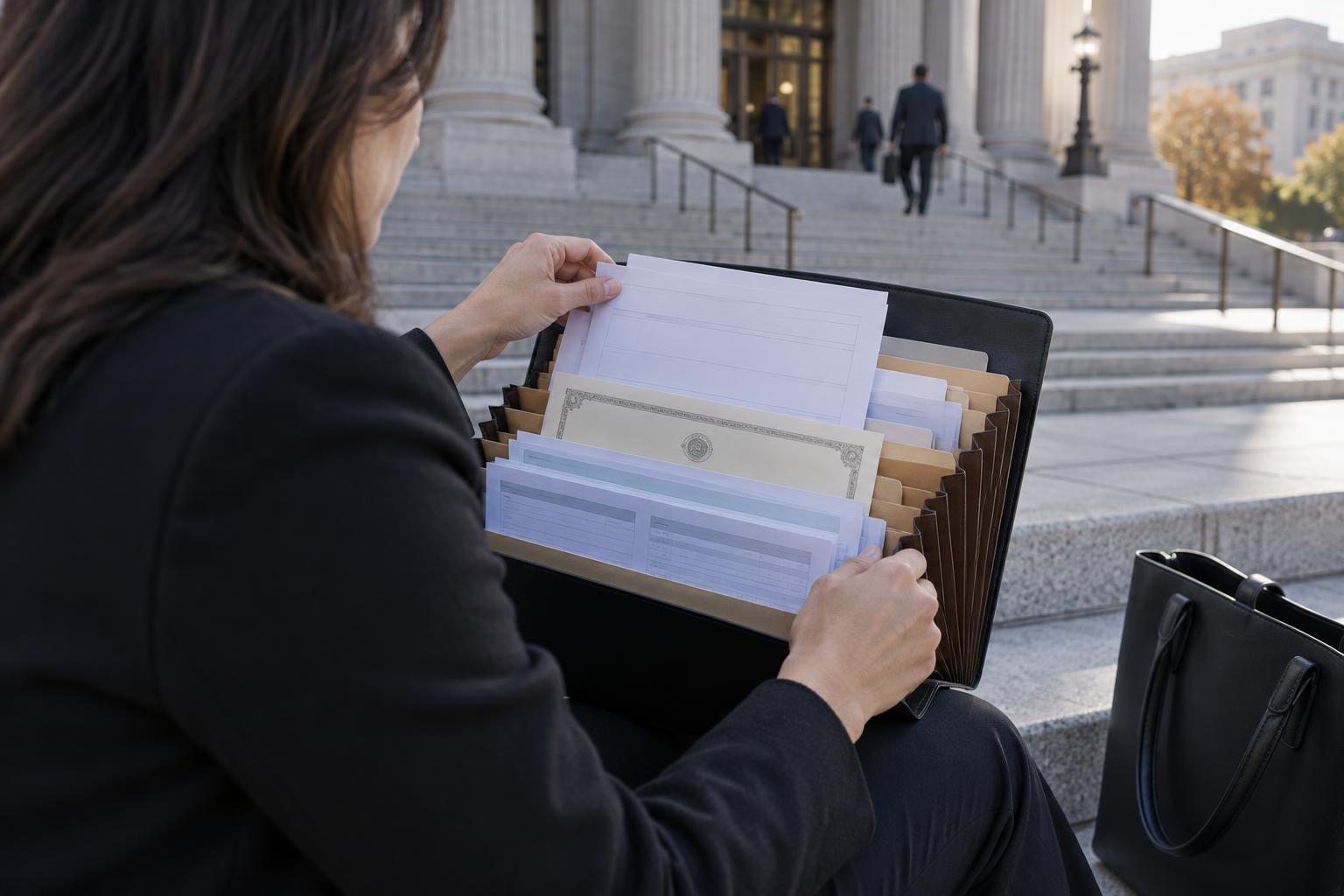
To file for divorce, you typically need a divorce petition or complaint, any required summons and local court forms, and a filing fee or fee-waiver request. Depending on your court and circumstances, you may also need forms addressing children, financial information, or existing court cases. Supporting records such as bank statements and tax returns are important, but many are exchanged later rather than filed with your opening paperwork.
The most useful first step is separating documents the court requires to start your case from records you need to understand and resolve your divorce. You do not necessarily need a complete financial archive before filing.
What court forms do you need to start a divorce?
There is no single nationwide divorce packet. Laws and procedures vary by state, and individual courts may require additional forms. Start with your state judiciary’s official website or your county court’s family-law self-help page—not a generic packet that may be outdated.
Look for instructions matching your situation, such as divorce with minor children, divorce without minor children, or a joint filing where available.
Common documents include:
| Document | What it does | When it may be needed |
|---|---|---|
| Petition or complaint for divorce | Opens the case and states the relief you are requesting | Usually at filing |
| Summons or citation | Gives formal notice of the case and response requirements | Commonly submitted for issuance when filing |
| Case information sheet | Provides administrative information about the parties and case | At filing if required locally |
| Confidential information form | Supplies protected identifiers separately from public documents | At filing or another required stage |
| Fee-waiver application | Requests relief from court fees based on eligibility | When filing if requesting a waiver |
| Child-related or financial forms | Provide information needed for custody, support, or disclosure | At filing or later, depending on local rules |
What information goes into the petition?
Expect to provide names, contact information, marriage details, and facts showing that the court can hear your case. You may also need to identify children, other court proceedings, and requests involving property, debts, support, or parenting arrangements.
Some forms ask for a separation date. That date can have legal consequences, and its meaning varies by state. If you are unsure which date applies, get advice rather than guessing.
The petition is not usually the place for a detailed account of the relationship. Answer the form’s questions accurately and follow instructions about signatures, notarization, or declarations made under penalty of perjury.
Do you need your marriage certificate or other personal records?
Some courts require a marriage certificate or other proof of marriage; others do not require it with the initial filing. Check the official instructions before ordering a certified copy or delaying your case.
Even when you do not need to attach supporting records, gathering the following can help you complete forms correctly:
- Your marriage date and place, supported by a marriage record if available.
- Current legal names and any former names relevant to the forms.
- Addresses and contact information, subject to safety protections.
- Information supporting residency requirements, if requested.
- Any prenuptial or postnuptial agreement.
- Existing divorce, separation, protective-order, or support case information.
- Government-issued identification if required for notarization or another filing step.
If you married outside the United States, ask whether the court needs a certified record, translation, or other authentication. Do not assume that marrying abroad prevents you from divorcing where you now live; jurisdiction depends on applicable law and your circumstances.
You may also need information about where your spouse can legally be served. Keep a reliable home or work address if you have one, but do not put a protected address into a public filing without checking the court’s procedures.
What financial documents should you gather?
Financial records help you complete disclosures, evaluate settlement proposals, and identify property and debts. They are not all automatically exhibits to your divorce petition.
The court’s disclosure rules determine what you must provide, to whom, and when. Required time periods differ, so use the local checklist rather than assuming a particular number of months or years is sufficient.
Income and taxes
Collect available records showing income from all relevant sources:
- Recent pay stubs and compensation statements.
- Federal and state tax returns, including schedules.
- W-2s, 1099s, and records of contract or self-employment income.
- Bonus, commission, stock compensation, and deferred compensation records.
- Benefit statements, including unemployment, disability, or retirement income.
- Business income and expense records if either spouse owns a business.
Tax returns may not tell the whole story, particularly when income fluctuates. Current records can help explain changes since the last tax year.
Assets and debts
Gather statements or records for checking and savings accounts, investments, retirement plans, real estate, vehicles, loans, and credit cards. Include assets and debts held in either spouse’s name, not just joint accounts, to the extent required by disclosure rules.
For a home, useful records may include the deed, mortgage statement, purchase closing documents, and available valuation information. For a business, useful materials may include ownership documents, financial statements, and business tax returns.
If you believe property is separate because you owned it before marriage or received it as a gift or inheritance, preserve records tracing its source and movement. An account’s title alone does not necessarily establish how the property will be classified.
Household expenses
Keep records of housing, utilities, insurance, transportation, childcare, medical costs, and other regular expenses. These can support a financial affidavit or budget used to assess support requests.
Separate current expenses from estimates of future costs. Label estimates clearly rather than presenting them as amounts you already pay.
What additional documents do parents need?
If you have minor children together, your opening packet may require additional information about custody jurisdiction, parenting arrangements, or support.
A common requirement is a declaration describing where the children have lived and with whom during a specified period. It may also ask about other custody proceedings or people claiming custody rights. Follow the exact form instructions; do not guess the required history.
Useful records to gather include:
- Children’s full legal names and birth dates.
- Birth certificates if the court or your attorney requests them.
- Address history and the names of people the children lived with.
- Existing custody, parenting-time, child-support, or protective orders.
- Information about pending cases involving the children.
- Childcare expenses and health insurance costs attributable to the children.
- Records of significant educational or medical expenses.
Some courts require a proposed parenting plan or child-support worksheet early in the case; others require these later. If parentage is disputed or has not been legally established, ask a local attorney how that affects the paperwork.
Avoid attaching extensive school or medical records unless they are required or relevant to a particular request. Those records can expose sensitive information without helping the court decide anything at the filing stage.
What if you cannot find documents or your spouse controls them?
Missing records do not automatically prevent you from starting a divorce. Whether a missing item blocks filing depends on what it is and what your court requires.
For a missing required court form, contact the clerk or self-help center. For missing financial evidence, make a list of what you have, what is missing, and who likely holds it.
You may be able to obtain copies through lawful sources:
- Request statements for accounts you are authorized to access.
- Ask your employer for pay or benefits records.
- Request copies of tax records you are entitled to obtain.
- Order marriage or birth records through the appropriate records office.
- Obtain available deeds or other public records from the relevant government office.
After a case begins, disclosure requirements and formal discovery may help obtain records from your spouse or third parties. An attorney can explain when document requests, subpoenas, or court enforcement are appropriate.
Do not guess on a sworn form, sign in your spouse’s name, or access accounts without authorization. Knowing a password does not necessarily mean you have permission to use it. If information is unavailable, ask how to disclose that properly and whether an update will be required.
If requesting documents could put you at risk, prioritize safety. A local domestic violence advocate or attorney can help you explore safer communication and address-confidentiality options.
How should you organize and protect divorce paperwork?
A simple filing system can reduce mistakes and make meetings with an attorney more productive. Create separate folders for court forms, income, assets, debts, children, agreements, and court orders.
Use descriptive filenames, such as “Checking-statement-April-2026,” and preserve complete documents, including all pages. Keep originals safe and submit copies unless the court specifically requires an original or certified copy.
Maintain a short document tracker with:
- The document’s name.
- Whether you have a complete copy.
- Where you requested missing information.
- Any filing or disclosure deadline.
- Whether it must be filed, served, or exchanged privately.
That final distinction matters. Giving a document to your attorney or exchanging it with your spouse is not the same as filing it in court. Filing may make information accessible in ways a private exchange does not.
Follow local rules for redacting Social Security numbers, account numbers, birth dates, and other protected information. Do not redact information that belongs on a required confidential form without checking the instructions.
Use a secure email account and storage location that your spouse cannot access without permission. If you suspect device monitoring, seek safety guidance before changing shared accounts or passwords, since changes can sometimes trigger alerts.
What should you check before submitting your documents?
Before filing, compare your packet against the court’s current checklist. Confirm that you are using the correct court, the right packet, and the latest available forms.
Then review these details:
- Completeness: Required questions are answered, and attachments are included.
- Consistency: Names, dates, addresses, and financial figures match across forms.
- Signatures: Each required signature, declaration, or notarization is complete.
- Privacy: Sensitive information is handled according to court rules.
- Fees: You have the required payment or a completed fee-waiver application.
- Submission requirements: You understand e-filing, paper-copy, and document-format rules.
- Next steps: You know how to obtain filed copies and arrange legally valid service.
Filing does not necessarily notify your spouse, and you generally cannot substitute an informal text or email for required service. Follow your jurisdiction’s service procedures and retain any required proof of service.
Court staff can often explain administrative requirements, but they generally cannot advise you about what to request or how a choice affects your rights. Divorcesify provides general information, not legal representation. Consider speaking with a local divorce attorney, especially if your case involves safety concerns, a business, disputed parentage, or children living in another state.
Key takeaways
- Start with your court’s official divorce packet; requirements vary by state and court.
- Separate opening court forms from supporting records and later financial disclosures.
- Check whether marriage records, child-related forms, or financial affidavits are required immediately.
- Gather records lawfully, and ask how to handle missing information rather than guessing.
- Protect sensitive information and confirm whether each document must be filed or exchanged privately.
- Review signatures, fees, service requirements, and deadlines before submitting your packet.
Frequently asked questions
Do I need every financial document before filing for divorce?
Usually, you do not need every financial record before opening a divorce case. However, some courts require a financial affidavit or other financial information at filing or soon afterward. Check your court’s instructions, gather what you can lawfully access, and ask how to handle missing information without making unsupported statements.
Is a marriage certificate required to file for divorce?
It depends on the court. Some require a marriage certificate or other proof of marriage, while others primarily ask for the marriage date and location on the petition. Check the official filing checklist before ordering a certified copy. Foreign marriage records may require a translation or additional authentication.
Where can I get the correct divorce forms?
Start with your state court system’s official website, your local court clerk, or a court self-help center. Choose forms that match your circumstances, including whether you have minor children. Confirm whether your county requires extra forms, and check for current versions before relying on an older downloaded packet.
Do I file bank statements and tax returns with my divorce petition?
Not necessarily. These records are often used for financial disclosures or exchanged between the parties rather than attached to the opening petition. Some courts require financial forms or supporting records at particular stages. Follow local filing and privacy rules, and avoid putting unredacted financial information into the public court record.
What if my spouse will not give me the documents I need?
You may still be able to file using the information and required forms available to you. Request records from institutions you are authorized to contact, and document what is missing. Disclosure rules and formal discovery may help obtain additional records after filing. A local attorney can explain appropriate requests and enforcement options.
Attorney advertising. Divorcesify is not a law firm, is not a lawyer referral service, and does not provide legal advice. Information on this site is general and may not reflect current law in your state. Using this site or submitting a form does not create an attorney-client relationship. Divorcesify matches visitors with independent, licensed attorneys who pay a fee to participate. We do not endorse or guarantee any attorney, and the choice of a lawyer is an important decision that should not be based solely on advertisements. Read full disclosures.
Get the Divorce Preparation Guide
Checklists, a post-divorce budget outline, and the questions to ask your first attorney — free.
Keep reading
Temporary Orders in Divorce: What They Do and How to Ask
Divorce can take time, but decisions about children, housing, and bills often cannot wait. Temporary orders can establish enforceable rules while your case moves forward.
Who Claims a Child on Taxes After Divorce?
The parent entitled to claim a child for federal tax purposes is not always the parent named in a divorce agreement. Learn how overnight stays, IRS Form 8332, and different tax benefits fit together.
How to File for Divorce in California: Step-by-Step
Filing for divorce in California starts with residency, court forms, and proper service—but those steps do not end the marriage. Follow this practical guide through disclosures, settlement options, and the final judgment.